Salt Lake City, UT Air Quality Index (AQI) Today
LIVERight now: Salt Lake City is at 31, good. The source is wildfire smoke, which reads about one band worse than traffic exhaust at the same number.
Is the air safe to breathe in Salt Lake City today?
Go
Normal outdoor plans. No change needed.
Short & unloaded
A 20-minute dog walk, not a 2.5-hour run. Keep it brief and easy.
Don’t go
Move it indoors. Above 200 that becomes everyone, not just sensitive groups.
Duration and intensity are two separate dials
| Under 20 min | 20–60 min | Over an hour | |
|---|---|---|---|
| Easy | Go | Go | Go |
| Moderate | Go | Go | Go |
| Hard | Go | Go | Go |
Where people actually draw the line
- 60 Asthmatic runnerone runner’s own 156-run log
- 75–100 Daycare / schoolWA 75/80, MN 100 — confirmed; most states not studied
- 100 Parentcommunity-reported, escalating at 150 and 200
- 110 Runnercommunity-reported
Wildfire smoke reads about one band worse than traffic exhaust at the same number. Several runners and asthmatics independently drop their cutoff when the source is smoke.
If you’re staying in, filter the room you’re actually in
Dominant pollutant
PM2.5
UV index
—
Forecast
—
That color and that number are today’s read on Salt Lake City air quality. What matters more is what it means for the walk, the run, or the kid’s recess you’re deciding about right now. This page tracks the air quality Salt Lake City actually breathes, day by day, not just one headline number. Skip refreshing it. Skip refreshing it yourself — a text when the inversion pushes past your number does the watching.
Salt Lake City’s last 30 days, not just today
One reading tells you nothing about the pattern behind it. This tracks the air quality Salt Lake City actually saw over the trailing 30 days. It’s rebuilt from the same hourly AQI feed as the number above. It also carries a count of days above AQI 100 in the last 12 months. IQAir and AccuWeather, plus aqicn and the state’s own monitor grid, all give you today’s number and nothing behind it. None show a metro’s actual shape over time. A single bad Tuesday that spikes and clears by Thursday still counts here. It doesn’t vanish the way it does on a page that only shows “now.”
Why is it hazy in Salt Lake City today?
Three things are usually going on when the sky looks wrong but the number reads moderate. The AQI is a 24-hour average, so a genuinely bad hour gets diluted by twenty-three calmer ones before it becomes a headline figure. The haze might be smoke sitting aloft, above the ground-level monitor actually breathing the air. Or the nearest working station is miles off, reporting for a different pocket of the valley.
None of that makes the haze fake. It means the number is one day averaged at one location, not a live photo of your street. A cold air pool you can see and ozone you can’t covers all six causes.
What is causing the bad air in Salt Lake City?
Two different problems wear the same number in Salt Lake City. In winter, the culprit is fine particulate matter (PM2.5) trapped low by a cold air pool over the Wasatch Front valley floor. In summer, the dominant pollutant flips to ground-level ozone, formed when sunlight cooks vehicle exhaust — invisible and odorless, unlike the visible winter smog.
Utah’s Division of Air Quality flags the worst of these as red air days. On a mandatory no-burn day, wood stoves and fireplaces are banned outright. Ozone at AQI 50 doesn’t look or smell like PM2.5 at AQI 50. That’s exactly why it fools people checking the sky instead of the reading. Occasionally it’s neither. A two-day windstorm can lift coarse dust (PM10, not PM2.5) off the valley floor and into the city, with no fire or inversion involved. One Salt Lake City resident described it bluntly — stepping outside during one of these dust events “felt like immediate death.”
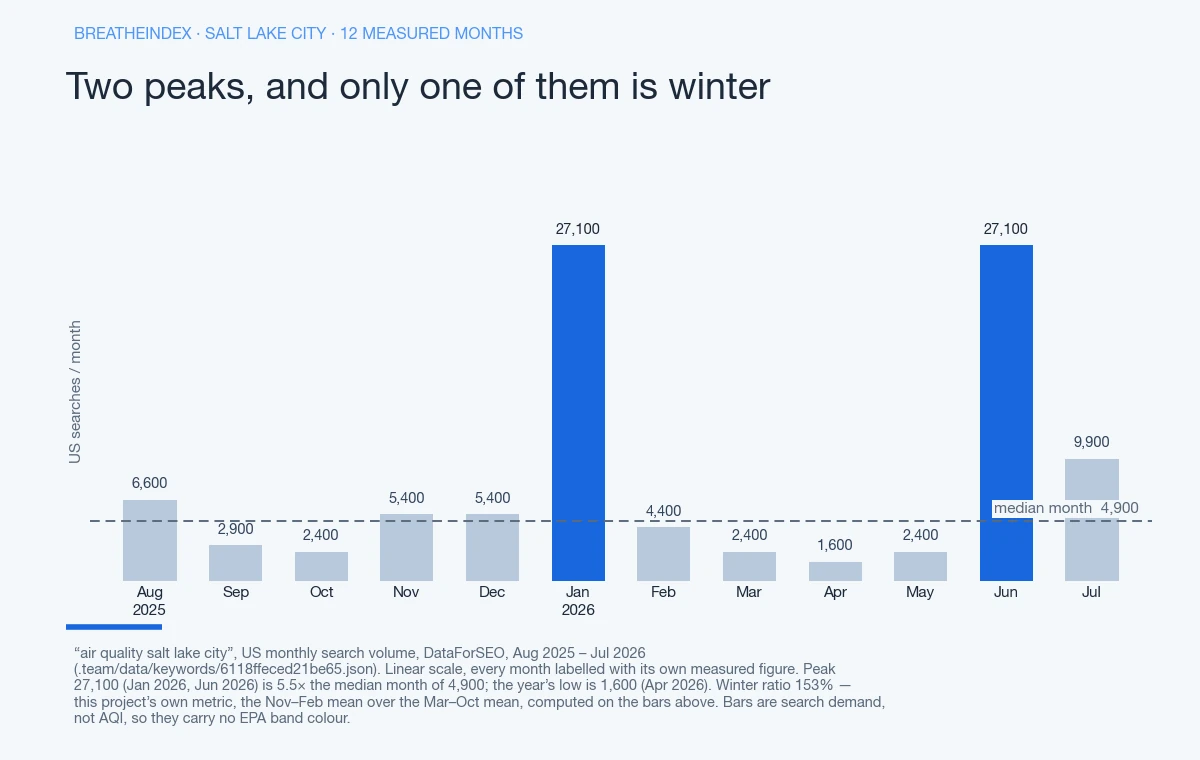 “air quality salt lake city”, DataForSEO, Aug 2025 – Jul 2026. Peak 27,100 (Jan 2026, Jun 2026) against a median month of 4,900. Winter ratio 153% (Nov-Feb mean over Mar-Oct mean). Bars are neutral blue-grey with the peak month in accent blue — never EPA band colours.
Is the air safe to breathe in Salt Lake City today?
There isn’t a single yes or no. There are three states, and picking the wrong one is the mistake people actually make. Go: nothing to adjust. Short and unloaded: an hour outside instead of three. Don’t go means what it says. Duration and intensity are two separate dials, not one.
Short and unloaded is the state people already invent for themselves without anyone telling them to. Watering the garden or walking the dog to the corner and back counts. Above roughly AQI 200 the call becomes a lockdown: everyone in, including the person who normally shrugs this off. On the EPA AQI breakpoints that’s the 201–300 band, Very Unhealthy. The switch to everyone actually starts a band earlier, at 151–200, Unhealthy. By 201–300 it isn’t a new group getting swept in. It’s the same everyone-warning getting worse. And a 20-minute dog walk at a given AQI is a different decision than a 2.5-hour run at that same AQI. One runner ignored that and ran two and a half hours at AQI about 90. He was “feeling pretty sick the following night, sweating heavily and coughing.”
What AQI should you stay inside?
A 1.8x spread separates a runner’s ceiling from an asthmatic’s: 110 against 60. “I’ll run in up to 110 because… error bars,” one r/Marathon_Training runner’s ceiling. An asthmatic runner set a far lower wall after logging 156 runs against AQI: 60. Past it, “my lungs struggle regardless of how well I’ve trained,” regardless of EPA calling nothing under 100 unhealthy.
Their own numbers back it up: 87% clean under 50, 42% from 50 to 70, 12% past 70. Runner to asthmatic, that’s a 1.8x spread for identical air. One runner logged 2.5 hours at roughly AQI 90 and was “feeling pretty sick the following night, sweating heavily and coughing.”
Wildfire smoke shifts that whole table down further, on top of the Wasatch Front’s own winter inversion pattern. EPA’s own term for 101–150 is Unhealthy for Sensitive Groups — attributed, and not a verdict on your lungs specifically.
Washington closes kids’ outdoor time at 75–80; Minnesota schools close at 100. No published Utah rule exists for daycares or schools, so none is named here — several other states, Wisconsin included, have none either. Which states publish a daycare AQI rule covers what’s confirmed. Ask your own provider for their written policy.
A portable unit in the room you’re actually using beats a whole-house fix that isn’t rated for your system. Default to a portable HEPA purifier or a Corsi-Rosenthal box — one community builder put a 12x14 bedroom box at roughly $130. Skip the MERV-13 whole-house swap until a licensed tech checks the static pressure; an undersized HVAC just struggles against it. Monitor before purifier, and why sets out the order.
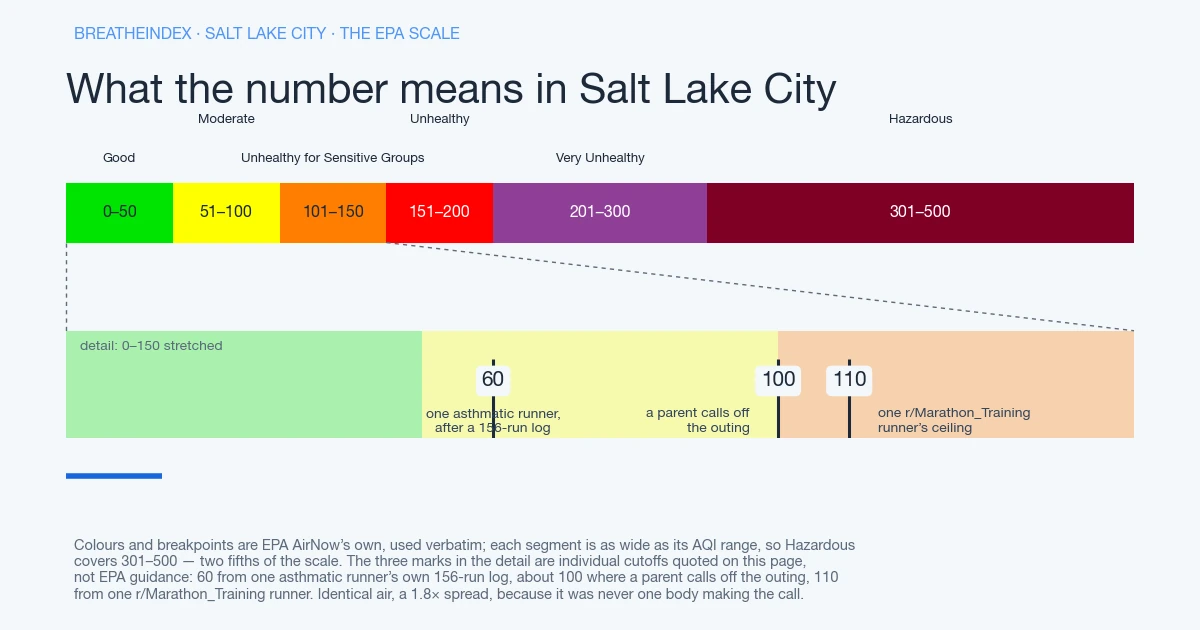 EPA AirNow’s own colours and breakpoints, segment width proportional to the AQI range. The three marks are individual reported cutoffs quoted on this page, not EPA guidance.
Why our number may not match what you are seeing and smelling
The mismatch cuts both directions here, and the second one is the trap nobody warns about. Direction one: the sky looks wrong but the number reads fine. Direction two: the sky looks clear, but ground-level ozone stays elevated without any visible cue. It’s the dominant summer pollutant here — invisible and odorless.
One person described exactly this blind spot: “telling people they’re breathing in a toxic invisible gas is a sure way to kill the vibe. But it must be done.” A parent stuck home with a toddler described the same trap from the inside. “My husband keeps saying it seems fine, it looks clear outside and doesn’t smell bad, but I feel like all the harmful stuff is invisible.” Clear skies and a clean nose aren’t the same test as a monitor. Ozone fails both.
Direction two: a genuinely hazy, smoke-smelling day where the posted number stays surprisingly low.
That’s the monitoring station feeding today’s reading, its distance from the metro centroid, and the nearby PurpleAir sensor count. A station miles from where you’re standing under-reports whichever side of the valley sits farthest from it. That’s usually where smoke pools without a sensor close enough to catch it. Where smoke pools without a sensor close enough to catch it is documented in full.
Why Salt Lake City air gets worse in winter
Search interest for air quality Salt Lake City peaks twice a year — January and June — with completely different machinery behind each. Winter’s is a temperature inversion: warm air settles over cold air trapped in the Wasatch Front valley, capping that cold air pool like a lid. Wintertime PM2.5 from cars, industry and wood smoke then builds for days with nowhere to vent.
Utah’s Division of Air Quality names the worst stretches red air days and calls a mandatory no-burn day when one hits. No wood stoves, no fireplaces, until the inversion breaks. It doesn’t break on its own. A storm front has to punch through the cap, which is why “wait for the next storm” is the real forecast through inversion season. One resident’s dry summary of how normal this gets: “This is considered a nice clear day in Salt Lake City.”
Summer’s peak is a different mechanism — wildfire smoke, not stagnant valley air. The valley trap isn’t ours alone. Boise gets the same wintertime cold air pool, while Reno’s year is shaped by fire season instead. Further out, Sacramento’s year has the same two peaks and Spokane’s does too — winter trap, then fire season — with different numbers behind each.
FAQ
What’s the air quality forecast for Salt Lake City tomorrow?
Inversion and wind can shift within hours, especially near a red air day. Treat it as a direction, not a lock, and check back the morning of.What’s the UV index in Salt Lake City today?
UV runs on its own scale, separate from AQI. A clear day is often the day UV is highest, so a good AQI isn't a reason to skip sunscreen.Who has the worst air quality in the US right now?
See how Salt Lake City ranks today against every tracked city. Its rank moves hardest in January and during active wildfire smoke.
When does the inversion end in Salt Lake City?
When a storm front mixes the valley out. There’s no fixed date. Watch for snow or rain in the forecast — locals treat an incoming storm as the real end-of-inversion signal.
Is it a no-burn day in Salt Lake City?
Utah's Division of Air Quality sets mandatory no-burn days during red air day conditions. Wood stoves and fireplaces are banned until it lifts. It's enforced, not a guideline. Set an [air quality action day alert](/alerts/) to know before you'd light one.Where this reading comes from
Salt Lake City, about 2.4 miles from the metro centre, with 11 nearby sensors.
The last 30 days in Salt Lake City
0 of the last 30 days were above AQI 100.
Questions people ask
What AQI should you stay inside?
Is it safe to exercise outside today?
Why does another app show a different number?
Updated