Atlanta, GA Air Quality Index (AQI) Today
LIVERight now: Atlanta is at 71, moderate.
Is the air safe to breathe in Atlanta today?
Go
Normal outdoor plans. No change needed.
Short & unloaded
A 20-minute dog walk, not a 2.5-hour run. Keep it brief and easy.
Don’t go
Move it indoors. Above 200 that becomes everyone, not just sensitive groups.
Duration and intensity are two separate dials
| Under 20 min | 20–60 min | Over an hour | |
|---|---|---|---|
| Easy | Go | Go | Go |
| Moderate | Go | Go | Go |
| Hard | Go | Go | Go |
Where people actually draw the line
- 60 Asthmatic runnerone runner’s own 156-run log
- 75–100 Daycare / schoolWA 75/80, MN 100 — confirmed; most states not studied
- 100 Parentcommunity-reported, escalating at 150 and 200
- 110 Runnercommunity-reported
If you’re staying in, filter the room you’re actually in
Dominant pollutant
PM2.5
UV index
—
Forecast
—
That color and number are today’s Atlanta read, nothing more. It decides the Piedmont Park run, the porch coffee, or the kid’s recess you’re weighing right now. This page tracks the air quality Atlanta actually breathes over the past 30 days, plus a pollen count the AQI itself never touches. Skip refreshing it. Set a threshold once and let the ozone days come to you, with the cause named in the message.
Atlanta’s last 30 days, not just today
One reading won’t tell you if today is ordinary or a spike. This chart rebuilds the air quality Atlanta has seen over the trailing 30 days, from the same hourly AQI feed as the number above. It also carries a running count of days above AQI 100 in the last 12 months. IQAir, AccuWeather and aqicn, plus Georgia’s own EPD monitor grid at airgeorgia.org, all show today’s number. None show the shape behind it, over time. A bad Tuesday that clears by Thursday still shows up here, instead of disappearing.
Why is it hazy in Atlanta today?
Most of the year, the usual three reasons apply. The AQI is a 24-hour average, so a genuinely bad hour gets diluted by twenty-three calmer ones before it becomes one headline figure. Smoke can sit aloft, above the ground-level monitor that’s actually breathing your street’s air. Or the nearest working Georgia EPD station sits miles off, covering a different pocket of the metro.
Spring in Atlanta runs on a different mechanism entirely, and it’s the one the AQI can’t see. Tree pollen counts here run in the thousands of grains per cubic meter, high enough to hang a visible yellowish haze over the whole metro on the worst days. The Air Quality Index doesn’t measure pollen at all. One resident, in a 2019 r/Atlanta thread, flagged a count “over 6,500 today, the highest this year.” A reply named the scale of it precisely: “5th highest count for ATL in recorded history” across 28 years of local record-keeping. Another explained the number itself, since raw grain counts mean nothing on their own. “Imagine a 3ft by 3ft by 3ft cube in front of you outside. That cube has 6,500 tiny individual grains of pollen in it. This is why when you look across a long distance on days like this you can see a vague yellowish haze.” A separate, later thread, dated 2020, a different spring and a different record, carried the title “Second Highest Pollen Count on Record in Atlanta.” Two different years, two different records, both real. Ozone you can’t see, and the pollen this number never counts sets out the national version.
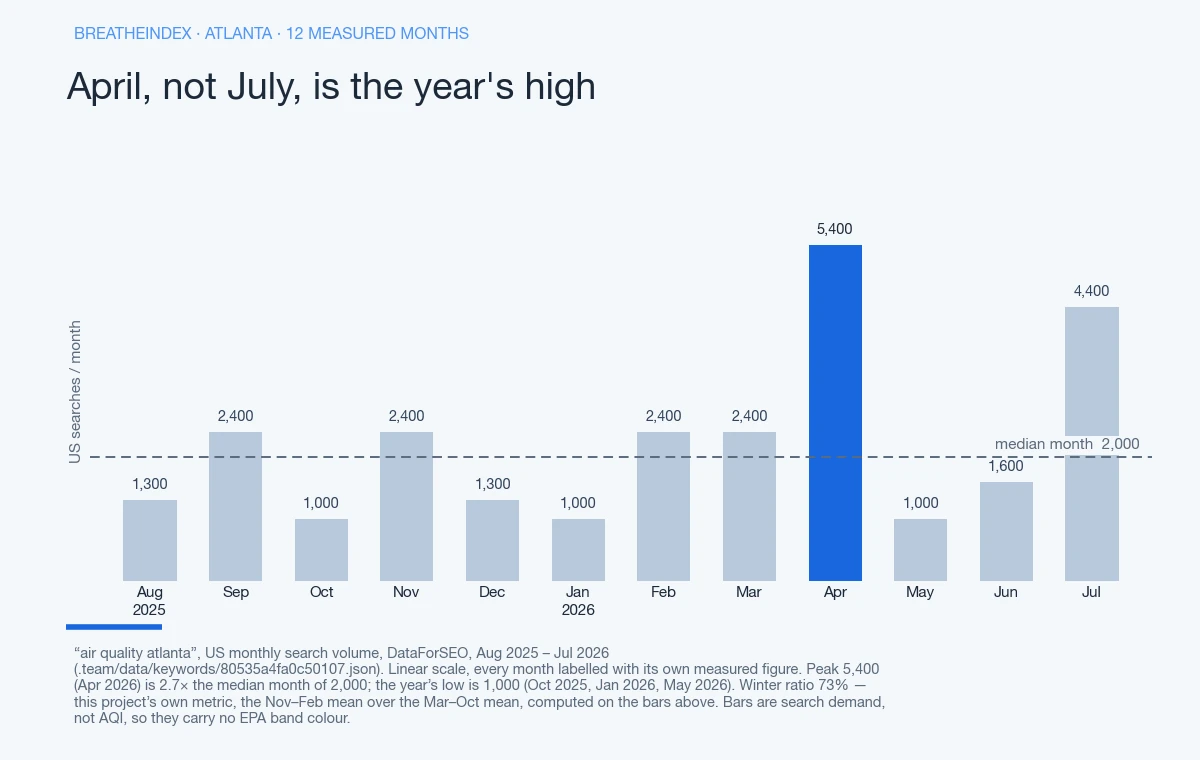 “air quality atlanta”, DataForSEO, Aug 2025 – Jul 2026. Peak 5,400 (Apr 2026) against a median month of 2,000. Winter ratio 73% (Nov-Feb mean over Mar-Oct mean). Bars are neutral blue-grey with the peak month in accent blue — never EPA band colours.
What is causing the bad air in Atlanta?
The air quality Atlanta reports runs on ground-level ozone through the warm months. That’s the same mechanism behind Denver’s summer smog, Houston’s ozone season and Phoenix’s summer ozone spikes. Sunlight cooks vehicle and industrial exhaust into ozone on hot, still afternoons, invisible and odorless. The American Lung Association’s 2025 State of the Air report ranked Atlanta 3rd worst metro in the Southeast for ozone pollution.
That’s also behind Los Angeles’s smog, longer than any of these. The report was published in April 2025. It’s tied for 4th worst for year-round particle pollution, and 34th worst out of 204 metro areas nationally. That’s a failing grade, and Atlanta failed the year before too.
Atlanta also sits at the southern edge of the Canadian wildfire-smoke corridor that reached New York in June 2023. That corridor broke the record again in July 2026, when Chicago’s AirNow feed climbed from 597 to 701 to 742 AQI between mid-afternoon and late that night. This project hasn’t sourced Atlanta’s own dated reading from either event, so no number is given for it here. The corridor’s southern reach is documented at the mechanism level, not as an as-it-happened Atlanta account.
Is the air safe to breathe in Atlanta today?
Atlanta’s worst air runs on summer ozone, not a trapped valley. Ozone builds through a hot afternoon and fades by evening, so the same number means something different at 8am than at 4pm. Go on Good or Moderate air. Short and unloaded — a shorter Piedmont Park loop instead of the long one — once the color moves to the middle of the scale. Don’t go past that.
EPA’s warning to everyone starts at 151, Unhealthy. 201 to 300, Very Unhealthy, says the same thing, louder — not a separate group. Past roughly 200, the evening run waits for tomorrow’s ozone to reset.
What AQI should you stay inside?
Georgia’s EPD hasn’t published an AQI cutoff for schools or daycares, at least nothing this project could confirm. Washington’s 75 and Minnesota’s 100, the only two confirmed names them. Ask your own provider for the written version too.
Atlanta’s summer heat adds to the ozone problem in a way the AQI number alone doesn’t show. “I’ll run in up to 110 because…error bars,” one r/Marathon_Training runner wrote, that’s their own ceiling. An asthmatic runner logged 156 runs against AQI and drew the line lower, at 60. Past it, “my lungs struggle regardless of how well I’ve trained,” despite EPA calling nothing under 100 unhealthy. Their success rate tracked it closely — 87% of runs under 50 went fine, dropping to 42% between 50 and 70, and just 12% past 70. Parents online tend to land near 100, between the runner’s high mark and the asthmatic’s low one.
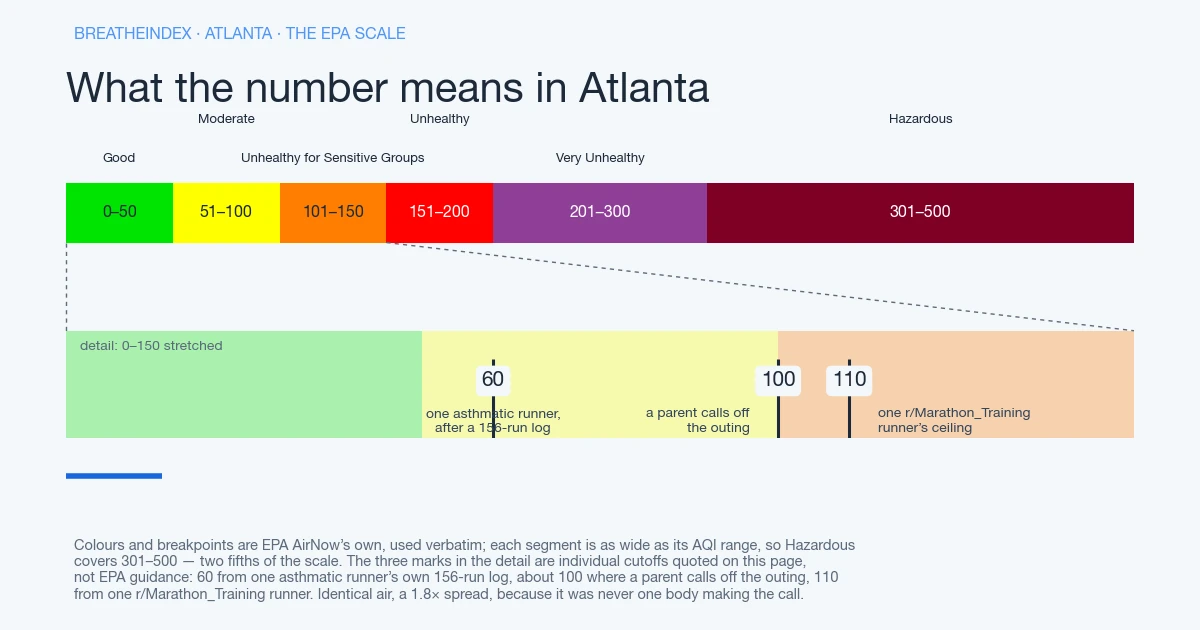 EPA AirNow’s own colours and breakpoints, segment width proportional to the AQI range. The three marks are individual reported cutoffs quoted on this page, not EPA guidance.
Wildfire smoke arrives from well outside Georgia. It still shifts that whole table down about one EPA band when it shows up. That 101–150 range is EPA’s code orange band, Unhealthy for Sensitive Groups — the agency’s classification, not a call on your lungs. Indoors, use a portable HEPA purifier or a Corsi-Rosenthal box. One community member priced a 12x14 bedroom build at $130. Skip the whole-house MERV-13 swap until a licensed tech checks the system’s static pressure. The three levers, in the order worth pulling is the indoor version.
Why our number may not match what you are seeing and smelling
This cuts both directions, and in Atlanta a third factor sits on top of both. Direction one: the sky looks wrong, but the number reads fine. Usually that’s the 24-hour averaging again, or smoke sitting aloft rather than at street level. Direction two: a clear, ordinary-looking day where the number has quietly climbed. Ground-level ozone is invisible and odorless, which is exactly why it fools people checking the sky instead of the reading.
The third factor is specific to Atlanta: the AQI can read Good while the sky still looks hazy yellow. Pollen just isn’t in the index. Pollen grains run far larger than the fine particulate matter (PM2.5) or coarse dust (PM10) the AQI actually measures — one reason the index misses it completely. A resident doesn’t need a bad AQI day to feel it. A bad pollen day does that on its own, AQI untouched.
That’s the monitoring station feeding today’s reading, its distance from the metro centroid, and the nearby PurpleAir sensor count. A station miles from where you’re standing under-reports whichever side of the metro sits farthest from it. How station distance and the 24-hour average shape this number is set out separately.
The pollen count Atlanta actually reports on
Atlanta is one of a small number of metros where the AQI genuinely isn’t the whole story. The thing making people miserable most springs isn’t tracked by it at all. One resident summarized the guidance a local clinic gives: keep car and house windows closed, change air filters regularly. Shower when getting home, and wear sunglasses and a mask outdoors.
That guidance is paraphrased, not quoted from a source document — the original description added “and definitely before crawling into bed” to the shower step. It traces back to the Atlanta Allergy and Asthma Center, the local authority residents cite by name in these threads, not a national aggregator.
One quirk in how this actually searches: Google shows no AI-generated overview on the Atlanta pollen count query at all. That’s one of three metros out of nine checked for this project — Atlanta, Houston and Minneapolis, and nowhere else. In its place, the top organic result is atlantaallergy.com — a real Atlanta clinic running its own metro pollen count, not a syndicated national number. That’s a rare case in this niche of a human-run source outranking every aggregator, AI summary included.
FAQ
What’s the air quality forecast for Atlanta tomorrow?
Ozone and wind direction can both shift within a day. Treat it as a direction, not a lock, and check back the morning of.What’s the UV index in Atlanta today?
UV runs on its own scale, separate from AQI. A good AQI reading is no reason to skip sunscreen, especially on the clear afternoons ozone likes best.Who has the worst air quality in the US right now?
See how Atlanta ranks today against every tracked city. The air quality Atlanta reports moves hardest during summer ozone season and during an active wildfire-smoke event. Its pollen count runs on an entirely separate, spring-peaking calendar.
Why doesn’t Google show an AI answer for Atlanta’s pollen count?
This project checked nine metro pollen queries; Atlanta is one of three — with Houston and Minneapolis — carrying no AI-generated overview at all. A real local clinic, not an aggregator, holds the top organic result for Atlanta’s pollen query instead.
Where this reading comes from
Atlanta, about 4.2 miles from the metro centre, with 9 nearby sensors.
The last 30 days in Atlanta
0 of the last 30 days were above AQI 100.
Questions people ask
What AQI should you stay inside?
Is it safe to exercise outside today?
Why does another app show a different number?
Updated