Bakersfield, CA Air Quality Index (AQI) Today
LIVERight now: Bakersfield is at 55, moderate.
Is the air safe to breathe in Bakersfield today?
Go
Normal outdoor plans. No change needed.
Short & unloaded
A 20-minute dog walk, not a 2.5-hour run. Keep it brief and easy.
Don’t go
Move it indoors. Above 200 that becomes everyone, not just sensitive groups.
Duration and intensity are two separate dials
| Under 20 min | 20–60 min | Over an hour | |
|---|---|---|---|
| Easy | Go | Go | Go |
| Moderate | Go | Go | Go |
| Hard | Go | Go | Go |
Where people actually draw the line
- 60 Asthmatic runnerone runner’s own 156-run log
- 75–100 Daycare / schoolWA 75/80, MN 100 — confirmed; most states not studied
- 100 Parentcommunity-reported, escalating at 150 and 200
- 110 Runnercommunity-reported
If you’re staying in, filter the room you’re actually in
Dominant pollutant
PM2.5
UV index
—
Forecast
—
That color and number are today’s read on Bakersfield air quality. What they’re actually deciding is the kid’s after-school practice, the dog walk, whether the windows stay open tonight. This page tracks the air Bakersfield has actually breathed over the past month, not just the one figure updating above. Skip refreshing it yourself — a text when the valley lid pushes past your number does the watching.
Bakersfield’s last 30 days, not just today
One reading says nothing about the shape behind it. This page rebuilds the air quality Bakersfield saw over the trailing 30 days, from the same hourly AQI feed as the number above. It adds a running count of days above AQI 100 in the last 12 months. IQAir, AccuWeather, aqicn and the state’s own monitor grid hand you today’s number, then stop. None of them renders the shape over time. Bakersfield’s worst stretches tend to cluster. A winter cold air pool settles in for days, not the single spike a coastal fire metro sees and clears. A bad week that runs into a second one still shows up here.
Why is it hazy in Bakersfield today?
Bakersfield sits on the floor of the San Joaquin Valley, walled by the Sierra Nevada to the east and the Coast Ranges to the west. In winter, cold air settles onto the flat valley floor while a warmer layer caps it from above. That’s a cold air pool, not a passing storm. Three things can also make the sky look worse than the number: 24-hour averaging, smoke sitting aloft, or a distant station.
The AQI is a 24-hour average, so a bad morning gets diluted across the calmer hours that follow it. Smoke from a fire elsewhere in the state can sit aloft, above the ground-level monitor doing the measuring, or the nearest working station is miles off, standing in for a valley that runs well past the city limits. None of that makes the haze fake — one number averages one location, not your block. A valley lid, an averaging window, a distant station walks through each cause in turn.
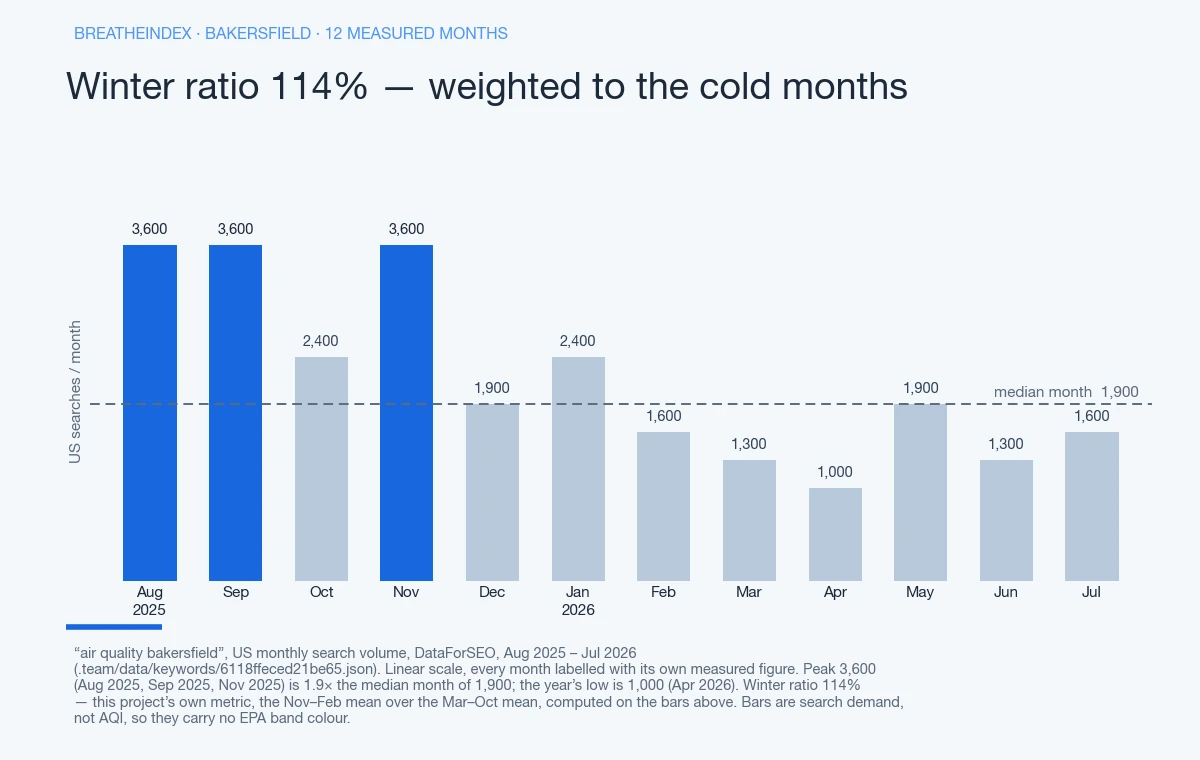 “air quality bakersfield”, DataForSEO, Aug 2025 – Jul 2026. Peak 3,600 (Aug 2025, Sep 2025, Nov 2025) against a median month of 1,900. Winter ratio 114% (Nov-Feb mean over Mar-Oct mean). Bars are neutral blue-grey with the peak month in accent blue — never EPA band colours.
What is causing the bad air in Bakersfield?
Two sources trade off across a Bakersfield year, and neither is a single wildfire event. In winter, fine particulate matter (PM2.5) from vehicle exhaust, wood smoke and agricultural burning gets trapped by the valley’s cold air pool. It can sit for days at a stretch. That’s the same broad mechanism behind Salt Lake City’s inversion, but in a wider, flatter valley, not a mountain-ringed bowl. In summer, the dominant pollutant flips to ground-level ozone.
Sunlight cooks vehicle exhaust into that ozone, and wind off dry agricultural land lifts coarse dust (PM10) into the mix. No Bakersfield-specific account of either mechanism turned up in the material reviewed. What’s confirmed is the San Joaquin Valley’s airshed pattern itself, not a resident’s own words — that’s what’s stated here, rather than an invented quote.
Is the air safe to breathe in Bakersfield today?
Three states, not a yes-or-no — and in a valley that holds air for days, picking the wrong one is the actual mistake. Go: nothing to change. Short and unloaded: an hour outside instead of three. Don’t go means exactly that. Duration and intensity are separate dials, not one.
Here the middle state does most of the work, because a cold air pool doesn’t clear overnight. A metro that spikes and clears asks the question once. Bakersfield can ask it every morning for a week. The dog walk to the corner instead of the full loop. Watering the yard instead of an hour of weeding. That is what a week of it actually looks like. Past roughly AQI 200 it stops being optional. Everyone goes in, including whoever normally shrugs this level off. On the EPA AQI breakpoints, “everyone” actually starts at 151–200, Unhealthy. 201–300, Very Unhealthy, is that same everyone-warning getting more serious, not a new group joining in. A 20-minute walk and a 90-minute run at the same AQI are two different decisions, not the same one twice.
What AQI should you stay inside?
Thresholds vary by person, wider than the EPA’s single “sensitive groups” line admits — a 1.8x spread runs from 60 to 110 for identical air. One asthmatic runner logged 156 runs against AQI and found their own cutoff at 60. Above it, “my lungs struggle regardless of how well I’ve trained,” though EPA calls nothing under 100 unhealthy.
On r/Marathon_Training, a runner put a number on it: “I’ll run in up to 110 because…error bars.” A parent weighing a toddler’s outdoor group, watching the number climb toward 100, called it “high yellow possibly into orange” in a comment online. Their own log backs the number up: 87% of runs under AQI 50 went fine, 42% between 50 and 70, and just 12% above 70. It isn’t one body making the call.
Wildfire smoke shifts that whole table down. “Smoke at AQI 50 feels way worse than pollution at AQI 50,” one commenter wrote. During active smoke, treat your usual threshold as about one EPA breakpoint band lower. 101–150 is what EPA calls Unhealthy for Sensitive Groups. That’s an attributed classification, not a verdict on your lungs specifically.
We haven’t found a published California daycare or school AQI rule, so we’re not naming one — ask your provider for their written policy. Which states publish a daycare threshold at all has what’s confirmed.
Indoors, default to a portable HEPA purifier or a Corsi-Rosenthal box — one builder in the community put a 12x14 bedroom box at $130. A whole-house MERV-13 swap isn’t the default. It can choke airflow in an undersized system, and the safe version needs a static-pressure check from a licensed tech first. What a MERV rating actually buys you has the rest.
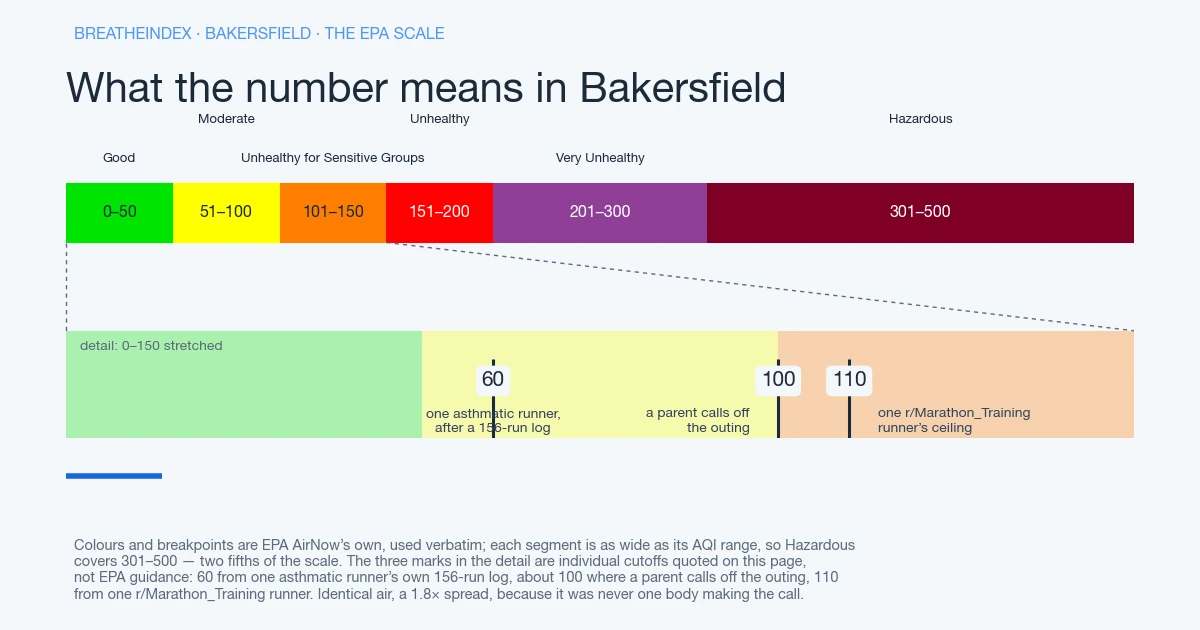 EPA AirNow’s own colours and breakpoints, segment width proportional to the AQI range. The three marks are individual reported cutoffs quoted on this page, not EPA guidance.
Why our number may not match what you are seeing and smelling
The mismatch cuts two directions here. A clear, still afternoon with no visible haze can still carry an AQI in the 100s. Ground-level ozone, summer’s dominant pollutant here, is invisible and odorless — check the number instead of the sky. A smoky-looking sky with a surprisingly calm number is usually the 24-hour average diluting a rough hour, or smoke sitting aloft above the monitor.
Neither direction is the fake one — the number and your senses are measuring different things.
That’s the monitoring station behind today’s reading — its distance from the metro centroid, and the nearby PurpleAir sensor count. A station miles off under-reports whichever side of the valley sits farthest from it. What a 24-hour average hides on a valley winter day is written up in full.
Why Bakersfield air gets worse in winter
Search interest for air quality Bakersfield runs counter to the national pattern: January measures 2,400 against a median month of 1,900. Bakersfield’s winter ratio — November-February mean against March-October mean — lands at 114%. That’s one of the few metros where winter, not a summer wildfire, drives the year’s peak search interest. The mechanism is the valley cold air pool.
Cold, dense air settles onto the flat San Joaquin Valley floor, and a warmer layer caps it from above. Wintertime PM2.5 from vehicles, wood smoke and agricultural burning builds up for days at a stretch, not one bad afternoon. That’s a different geometry from Salt Lake City’s inversion, which forms in a narrower valley ringed by the Wasatch Front — the San Joaquin is broad, flat and agricultural. Highway and farm-related dust are part of the mix in every season, not only winter.
Summer flips the mechanism again: ground-level ozone from sunlight and vehicle exhaust, plus PM10 dust off dry agricultural land, both peak in the warmer months. The cold air pool is what gives air quality Bakersfield a real winter season, unlike most fire-driven Western metros. Fresno shares this same valley floor and cold air pool, and Sacramento sits at the valley’s northern end with the same wintertime trap.
FAQ
What’s the air quality forecast for Bakersfield tomorrow?
A valley cold air pool in winter, or a shift in wind, can change this within hours. Treat it as a direction, not a lock — recheck the morning of.What’s the UV index in Bakersfield today?
UV runs on its own scale, separate from AQI. A clear, low-AQI day is often the highest-UV day of the week, so a good air quality reading isn't a reason to skip sunscreen.Who has the worst air quality in the US right now?
See how Bakersfield ranks today against every tracked city. Its rank moves hardest during winter inversion and active wildfire smoke.
What is in the air in Bakersfield right now?
That's today's specific reading. As a rule, winter runs on PM2.5 trapped by the valley's cold air pool; summer flips to ground-level ozone and agricultural PM10 dust.Why does it smell like smoke outside in Bakersfield?
Wildfire smoke and wintertime wood smoke can smell similar, but from different sources. One is burning vegetation from a distant fire, the other is heating smoke trapped locally by the valley’s cold air pool. If a specific fire is active, How long a plume usually sits before it clears is the briefing for that.
Where this reading comes from
Bakersfield, about miles from the metro centre, with nearby sensors.
The last 30 days in Bakersfield
0 of the last 30 days were above AQI 100.
Questions people ask
What AQI should you stay inside?
Is it safe to exercise outside today?
Why does another app show a different number?
Updated